
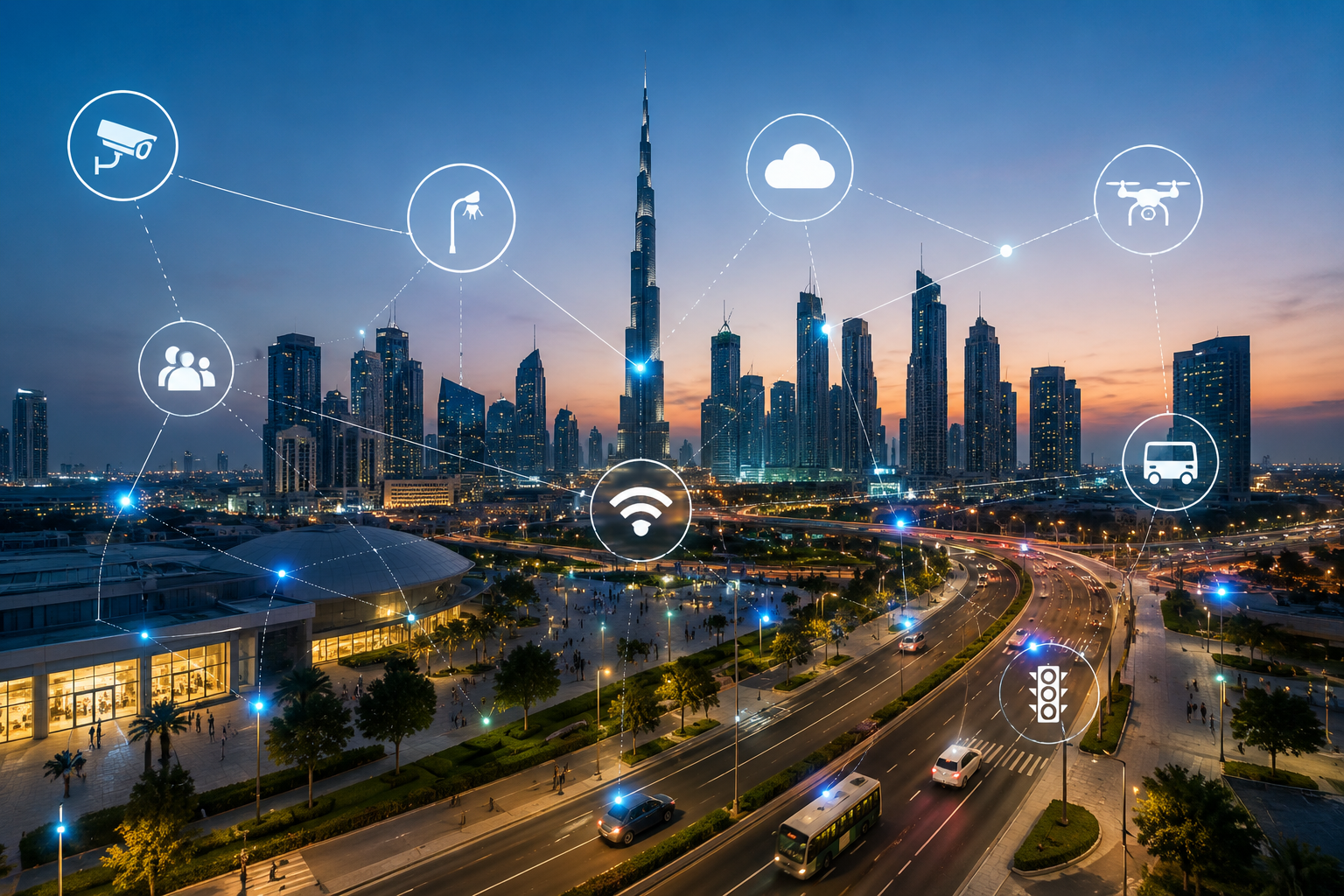
It is true that the UAE has set a global standard for ambitious, technology-led change. Whether we talk about smart cities and connected devices, intelligent transportation, next generation logistics, energy optimization, and digitally delivered public services, the country is slowly forming an economy where data driven decision can mean high growth potential. The Internet of Things (IoT) is one of the most compelling technologies driving this transformation. In 2026, IoT regains its definition as a term that ceases to be confined to connected devices and sensors but becomes the strategic force shaping operational excellence, new digital services, and overall modernization of the enterprise.
With IoT, enterprises can collect real-world information in real time, integrate physical operations and systems with digital ones, and respond to events quickly across vast dynamics. With UAE organisations and public sector entities ramping up their digital transformations, IoT is here to drive increased efficiency, less waste, improved safety, and more intelligent customer experiences. This is how IoT is fueling digital transformation across the UAE, the use cases driving industry and government change, and the top technologies that form a foundation for successful IoT time after time. These are also some of the strategies that can help companies scale IoT well in the years to come.
IoT In the Context Of Digital Transformation
IoT is networks of physical objects that are embedded with sensors and communications, then collect, exchange, and act on data from a variety of sources. Things can be anything, from sensors in industrial equipment or a smart meter to a camera, an automobile, or wearables such as jackets and shoes. It is not the device that makes IoT transformational, however, but the end-to-end system: sensing, connectivity, data pipelines, analytics and automated action.
And Digital Transformation is the process of using technology to improve your business model, service delivery, and operational efficiency. “IoT underpins transformation in connecting up the physical and digital world. It turns real-world activity into digital signals, which can then be scrutinized and engineered. In 2026, a multitude of UAE businesses will augment IoT with cloud platforms, AI applications, edge computing, and innovative modern enterprise solutions to provide new capabilities that traditional IT could not before.
Why is there a rapid growth of IoT in the UAE
The UAE is particularly fertile ground for the internet of things (IoT), given its digital infrastructure, significant smart city investments and an abundance of innovation-led thinking in the public and private sectors. Companies in the UAE work in hyper-instrumented and high-performance environments such as airports, ports, logistics corridors, industrial estates, mega real estate developments, and infrastructure systems. Such environments have to deal with a huge amount of operational data, while IoT can be used as a means of gathering, processing, and reacting to that data in an efficient way.
The business requirements for operational resilience are another driver behind IoT growth. Businesses don’t want to simply reactively respond to downtime; they desire predictive visibility into assets and systems that allow them to prevent failures. Internet-of-Things offering real-time surveillance and early warning signals. With it, sustainability goals can be better supported through energy efficiencies, less waste and more effective resource planning. With digital sophistication, IoT is moving from just a pilot technology to more of an underlying piece in enterprise modernization projects.
The Role of IoT in Delivering Digital Transformation Results
IOT brings change by giving you measurable results. The generalizable results are greater ability for real-time visibility, smarter stock decision-making, warehouse automation, better customer experience, and new service models. And when organizations have real-time visibility into operational conditions, they can make decisions more quickly and with less uncertainty. Once such data is combined with analytics, they can begin to predict what’s happening next and improve on it. They free up manhours and ensure consistency by automating them.
IoT also supports customer-facing transformation. For instance, smart building technologies can offer tenants app-based access controls and insights into energy consumption. It is easy to hand over the delivery tracking and predict the delivery for customers by using intelligent logistics. Smart health monitoring towards patient care with hospital offloading. There is no doubt that these results will result in greater competitiveness and better service levels throughout the UAE.
How the IoT is Transforming Industries in the UAE?
The influence of IoT in the UAE is widespread, and nowhere does this appear more evident than by examining industry use cases. IoT use cases are unique to individual industries, and one size does not fit all.
Smart Cities and Urban Infrastructure
The UAE smart city projects are largely relying on IoT for urban efficiency and quality of life enhancement. Sensors and connected systems track traffic flow, parking availability, streetlights, waste disposal, air quality, and public safety. These systems also contribute to dynamic optimization at a finer granularity, such as traffic lights whose timing can change depending on congestion or waste collection schedules based on the actual fullness of bins rather than some fixed route.
IoT for smart cities also contributes to sustainability and user comfort. By keeping an eye on energy consumption and environmental conditions, city managers can cut down waste and respond quickly to problems. By 2026, leading smart city solutions combine IoT data into centralized platforms, enabling predictive planning and proactive maintenance.
Energy, Utilities, and Sustainability
Energy and utilities are one of the leading IoT adopters due to their asset-intensive businesses. Seventy Smart meters, grid sensors, and equipment monitoring systems offer visibility into consumption habits, the health of systems, and anomalies in performance. How IoT can support utilities in minimizing losses, identifying faults early, and ensuring a more reliable service offering.
From an enterprise perspective, IoT enables achieving the sustainability objectives via energy optimization. Intelligent building management systems constantly watch HVAC performance, lighting, and presence, ensuring that the business reduces consumption without impacting comfort. In the UAE, where megaprojects in real estate and construction are on a monumental scale of size, even marginal efficiency gains can add up to large cost and environmental benefits.
Logistics, ports and supply chain operations
IoT is well-suited to ports, warehouses, and transport networks in the UAE thanks to its status as a logistics hub. IoT shipments monitor the condition of shipped items, the location of containers, the health of vehicles, and the movement of assets in a warehouse. This increases the visibility of your supply chain and eliminates waste caused by delays, misrouting or mishandling.
By 2026, IoT is more and more integrated with predictive analytics to provide for arrival times, best routes, and disturbance anticipation. Enterprises leverage this visibility to enhance customer communication, minimize inventory buffers and overall supply chain efficiency. IoT also accommodates regulatory and safety requirements by monitoring temperature and humidity for products like pharmaceuticals or food.
Manufacturing and Industrial Operations
The industrial Internet of Things had emerged as a primary catalyst for disruption in manufacturing, construction and heavy industry. Sensors monitor machine operation, vibration levels, temperature and operating cycles. This is known as predictive maintenance, being able to predict and avoid failures before they occur.
Quality can also be assured through connected inspection tools and computer vision within IoT. Production lines can be observed on an ongoing basis, with deviations prompting immediate remedial measures. That’s where IoT-enabled monitoring can improve reliability and lower operating risk, particularly in industrial settings in the UAE where uptime and safety are essential.
Healthcare and Connected Patient Services
For consumers, healthcare IoT would cover things like remote patient monitoring, connected medical devices, equipment tracking, and building/space monitoring in hospitals. In the year 2026, numerous health care systems are seeking a balance of patient experience and resource utilization. Continuous health check can be performed through IOT Without visiting hospitals, unnecessary and more proactive.
It also streamlines operations by identifying the location of medical devices, tracking usage patterns, and verifying that environmental conditions are appropriate for clinical workflow. These features also help ensure the safe and efficient delivery of healthcare as the UAE further increases its capacity for healthcare delivery through digital services, etc.
Retail, Hospitality, and Customer Experience
Retail & Hospitality The IoT enables customer experience and operations in retail and hospitality –a smart shopping cart is introduced by Amazon, providing instant reminder on the sophisticated end of supermarkets. From smart shelves to footfall sensors, from connected POS to environment monitoring, retailers can observe customer behavior and improve store performance. Using connected-room systems and smart energy controls, hotels and the places that host them are increasing guest comfort even as they lower their energy bills.BlackRock research showed IoT-based personalization is also gaining traction, with connected systems providing more personalized experiences. Such enhancements can help in the already-competitive customer service-led market of the UAE to build more brand differentiation and loyalty.
Real Estate and Smart Buildings
The UAE real-estate scene is among the most progressive in the world and smart building IoT is a major catalyst for change. Sensors are so critical for building management systems to monitor occupancy, power consumption, air quality and equipment performance. That makes it conducive to predictive maintenance, higher tenant comfort and cheaper operations.
Smart buildings also connect to mobile apps for access control, visitor management and service requests. With the UAE accelerating towards more digitally integrated living and working spaces, creating IoT in buildings is soon to become a key consideration of contemporary real estate value.
The Technology Foundations for Successful IoT Initiatives. Networking is the Foundation of your Iot Deployment. The Azure cloud offers a broad array of networking services to globally connect IoT devices.
Devices and sensors are the input layer that record data coming from the physical world. Connectivity is next using Wi-Fi, cellular networks, LPWAN (low-power wide-area network) technologies, or wired interfaces, depending on the environment and use case.. Streams are captured and directed into platforms where they can be stored and analyzed by data ingestion/processing/validation systems.
Scalability: Scalable for storage, and analytics is enabled on the cloud platforms. Low-latency processing is commonly referred to as edge computing, which enables devices that can take action locally when needed. Analytics and AI layers crunch raw data to generate insights, like predicting failures or spotting anomalies. Last and certainly not least, integration ties the insights derived from IoT into systems of business value such as ERP, CRM, and maintenance platforms — now we can act.
By 2026, enterprises deploying IoT initiatives will be more likely to consider and use scaled architectures for those projects; scalable across the sites, use cases and business units.
A recipe for success (IoT + AI) in the UAE
IoT produces data, but AI builds intelligence out of that data. IoT paired with machine learning is being applied in many UAE companies to deliver predictive and automated solutions. Predictive maintenance leverages AI models that are trained on sensor data to predict equipment failures. IoT in planning. Utilize IoT-derived data from supply chain operations for demand forecasting. Anomaly detection finds abnormal patterns in the data, which are then flagged as security threats or operational problems.
In smart city deployments, AI can leverage IOT data to ensure traffic flow, respond more quickly and effectively on public safety issues, and anticipate infrastructure maintenance requirements. It is this IoT + AI tandem that enhances transformation, as it moves organizations from observing to action.
Security and Governance Issues for IoT Transformation
New security and governance concerns are ushered in by the IoT transformation. Attack surface grows with connected devices. Unprotected devices may be used as gateways into company systems. Privacy of data is also crucial, particularly when personal data is collected by IoT systems using cameras, location tracking, and/or user interactions.
Best-in-class IoT programs deploy best practices for security, such as device authentication, communications encryption, secure firmware updates, and network segmentation. Governance itself makes content usage, control, and availability visible. It is critical for IoT to securely scale in the UAE’s enterprise landscape, which makes security-by-design a must.
Barriers to IoT Adoption and How to Overcome Them
A lot of IoT projects would not scale because businesses don’t know what they are trying to accomplish, their architecture is piecemeal, or the reality was underestimated. Some companies send them out without articulating how the data will be used and linked to decisions. Others battle with interoperability, the ability for devices from different manufacturers to work together seamlessly.
To break down these barriers, companies should begin with clear use cases that are tied to quantifiable KPIs. They need to begin with an architecture that scales and turn the key on integration as well as focus on using standard protocols. They should also invest in operational readiness, such as device management, monitoring and maintenance, etc.
More than anything, companies should view IoT as an enduring capability rather than a one-time project. To scale, you need governance, platform ownership and continual improvement.
An Approach to Scale IoT in the UAE
Select high-impact use cases that will translate to quick wins: A winning IoT transformation strategy starts by selecting a couple of impactful use cases. These wins increase stakeholder confidence and financial growth. They should rationally roll out their IoT platform so it can onboard devices in a consistent way, ingest data, analyze data and manage security.
Edge computing should be applied when latency and reliability are concerns, particularly in industrial and safety-critical sectors. Enter AI incrementally, beginning with descriptive analytics and progressing to predictive and prescriptive intelligence. Security should be built in at all levels — from device identity to data access controls.
Last but not least, change management is part of any IoT project. That requires that users be trained, dashboards be navigable, and workflows be updated to reflect the insights IoT provides. People benefit when they trust in the system, so adoption will grow while transformation is sustainable.
What’s Next for IoT-Driven Transformation in the UAE
Over the next few years, IoT in the UAE will evolve towards greater autonomy. Interconnected automation will be facilitated by more real-time infrastructure. Intelligent mobility systems will mass-flush data to streamline traffic and minimize emissions.
IoT will also become more integrated with digital identity, security frameworks, and enterprise platforms. As organizations mature, IoT will shift from isolated projects to a unified digital nervous system powering continuous insight and action.
Conclusion
IoT is driving digital transformation across the UAE by connecting physical operations to intelligent digital systems. Through real-time monitoring, predictive analytics, automation, and integrated services, IoT helps enterprises and public-sector organizations improve efficiency, reliability, safety, and customer experience. The most impactful IoT programs combine strong architecture, secure governance, AI-driven intelligence, and operational readiness to scale across use cases and environments. As the UAE continues advancing its smart economy ambitions, IoT will remain a central technology enabling sustainable, data-driven transformation. With expertise in end-to-end IoT strategy, platform engineering, integration, and scalable deployment, carmatec digital helps UAE organizations build IoT solutions that deliver measurable business value and long-term transformation impact.






 English (UAE)
 العربية