

Introduction
In the dynamic landscape of the UAE digital economy, the traditional “waterfall” approach to software delivery is rapidly becoming a relic of the past. For Chief Information Officers (CIOs) and technology leaders across UAE, the conversation has shifted from if they should adopt DevOps, to how fast they can scale it.
As UAE sprints towards the ambitious goals of Vision 2031, the pressure on digital infrastructure is immense. Whether it is a government ministry launching a new citizen-facing application or a Riyadh-based Fintech scaling to meet SAMA (UAE Central Bank) regulations, the demand for speed, reliability, and security is non-negotiable.
This is where DevOps-the cultural and technical convergence of Development and Operations-becomes a strategic imperative. It is no longer merely about automating scripts; it is about fundamentally restructuring how value is delivered to the end-user. This article provides an in-depth analysis of DevOps adoption in UAE, offering a practical roadmap for enterprises aiming to mature their software engineering capabilities.
Understanding DevOps for Modern Enterprises
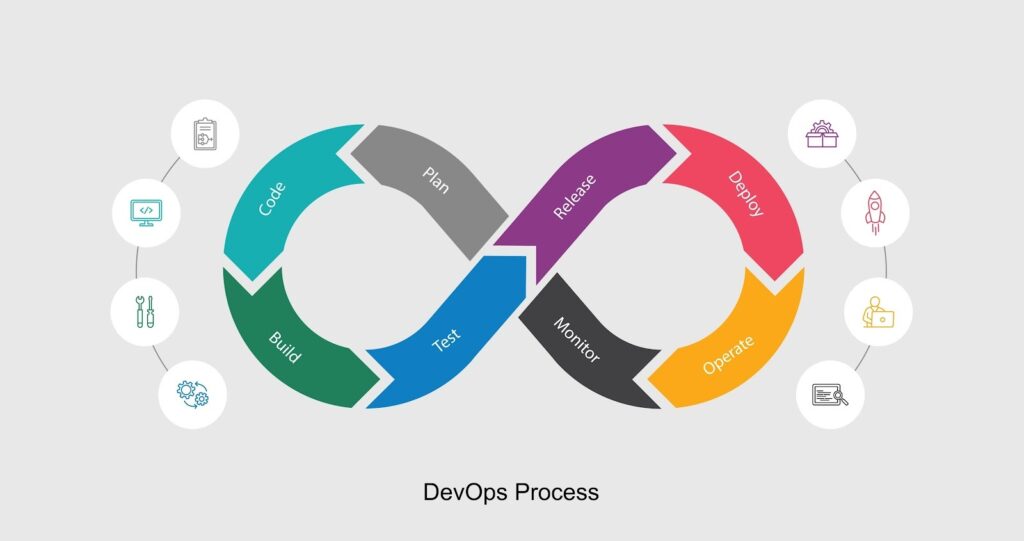
Before diving into the local context, it is crucial to align on what modern DevOps entails for an enterprise. It is not simply buying a CI/CD tool. True DevOps is the application of lean manufacturing principles to software development. It breaks down the silos between the developers who write code and the system administrators who maintain infrastructure.
For a large UAE enterprise, this means moving away from quarterly release cycles – which are fraught with risk and downtime-to on-demand deployments that are automated, tested, and secure by design. It is the transition from “ticket-based” infrastructure provisioning to Infrastructure as Code (IaC), enabling teams to move at the speed of the market.
Why DevOps Adoption Is Accelerating in UAE
The surge in DevOps UAE adoption is not happening in a vacuum. It is being propelled by a convergence of national strategy, regulatory frameworks, and infrastructure maturity.
The National Transformation Program and Vision 2031 place digital transformation at the core of economic diversification. To build a “Smart Government” and a thriving digital economy, public and private sectors must iterate software quickly. DevOps provides the engine for this agility. The mandate to digitize services – from healthcare to municipal permits – requires a delivery pipeline that is robust and scalable.
Key DevOps Trends in UAE
As software engineering UAE matures, several sophisticated trends are emerging within the local market.
Infrastructure as Code (IaC) Standardization
Manual server configuration is disappearing. UAE enterprises are standardizing on tools like Terraform and Ansible to define infrastructure. This ensures that a staging environment in Jeddah is mathematically identical to a production environment in Riyadh, eliminating the “it works on my machine” syndrome.
Kubernetes & Containerization
There is a massive shift toward microservices. Kubernetes adoption in UAE is skyrocketing as organizations break down monolithic legacy applications. Containerization allows these applications to be portable, scalable, and resilient, fitting perfectly with the multi-cloud strategies many UAE CIOs are adopting.
Shift-Left Testing and Security
In the past, security was a bottleneck at the end of the development cycle. Today, leading UAE firms are “shifting left” – integrating security scans and automated testing early in the CI/CD pipeline. This ensures that vulnerabilities are caught during the coding phase, not the deployment phase.
Platform Engineering
We are seeing the rise of “Platform Engineering” teams within large UAE conglomerates. Instead of every development team managing their own DevOps stack, a central platform team builds an Internal Developer Platform (IDP). This allows developers to self-serve infrastructure in a compliant, standardized way, boosting productivity.
Benefits of DevOps for UAE Enterprises
Why should a UAE CTO invest budget and cultural capital into this transformation? The ROI is tangible across several vectors.
- Faster Time-to-Market: In the competitive UAE market, being first matters. DevOps pipelines allow companies to release features daily or weekly rather than annually.
- Improved Reliability & Stability: Automated testing and rollback capabilities mean that deployments rarely cause outages. This is critical for sectors like Banking and Telecom.
- Higher Deployment Frequency: By deploying smaller changes more often, the risk associated with each release is minimized.
- Enhanced Collaboration: Breaking down silos creates a culture of shared responsibility. Developers understand infrastructure constraints, and Operations teams understand application logic.
- Better Cost Control: With dynamic scaling and IaC, resources are spun up only when needed and spun down when not, preventing the “zombie server” sprawl common in traditional data centers.
- Regulatory Compliance: Automated pipelines create an immutable audit trail of who changed what and when, simplifying audits for SAMA or NCA compliance.
Challenges in DevOps Implementation in KSA
Despite the enthusiasm, the road to DevOps adoption UAE is not without hurdles.
1. Legacy Monolithic Systems
Many established UAE banks, energy companies, and government entities rely on core systems built decades ago. These heavy monoliths do not easily lend themselves to CI/CD pipelines or containerization, requiring a complex “strangler fig” pattern to modernize.
2. The Talent Gap
There is a fierce war for talent. Finding experienced DevOps engineers, Site Reliability Engineers (SREs), and Cloud Architects in the local market is challenging. While initiatives like the Tuwaiq Academy are helping, demand currently outstrips supply.
3. Cultural Resistance
Hierarchy and rigid approval processes in traditional UAE organizations can clash with the DevOps philosophy of autonomy and rapid iteration. Moving from a “change control board” to automated approvals requires a significant cultural mindset shift.
4. Compliance and Data Sovereignty
While cloud regions are opening, navigating the nuance of what data can sit where (Public vs. Private cloud) under the new PDPL remains a complex task for enterprise architects.
DevOps Roadmap for UAE Enterprises
For organizations looking to structure their DevOps roadmap for enterprises, we recommend a phased approach to ensure sustainability.
Phase 1: Assessment & Strategy
- Audit: Evaluate the current software delivery lifecycle (SDLC). Identify bottlenecks (e.g., manual testing, slow provisioning).
- Goal Setting: Define success metrics (e.g., reduce deployment time from 3 days to 3 hours).
- Team Structure: Identify a “Tiger Team” to pilot DevOps practices before a company-wide rollout.
Phase 2: Foundation & Tooling
- Version Control: Ensure all code and configuration are in a system like Git.
- CI Implementation: Set up Continuous Integration to automate builds and unit tests.
- Cloud Setup: Establish a secure landing zone in a local cloud region (e.g., AWS KSA or Oracle Cloud Jeddah).
Phase 3: Automation & Containerization
- Adopt IaC: Begin managing core infrastructure using code.
- Containerize: Dockerize applications to ensure consistency.
- CD Implementation: Automate the deployment process to staging environments.
Phase 4: Observability & Security
- Monitoring: Move beyond uptime checks to deep observability (logs, metrics, traces).
- DevSecOps: Integrate automated security scanning (SAST/DAST) into the pipeline.
Phase 5: Scaling & Optimization
- GitOps: Manage cluster states via Git repositories.
- SRE Adoption: Implement Site Reliability Engineering practices to manage service level objectives (SLOs).
Recommended DevOps Tools & Ecosystem
A successful cloud-native UAE market strategy relies on a robust toolchain.
- AWS DevOps & Azure DevOps: Comprehensive suites that offer end-to-end management, highly favoured in KSA for their integration with local cloud regions.
- GitLab / GitHub: The standard for source code management. Their CI/CD features (GitLab CI, GitHub Actions) are increasingly replacing standalone build servers like Jenkins.
- Docker & Kubernetes: Docker is the standard for creating containers, while Kubernetes (often managed via EKS, AKS, or OpenShift) is the de facto orchestration platform for scaling them.
- Terraform: The industry leader for Infrastructure as Code, allowing teams to provision resources across AWS, Azure, and OCI using a single language.
- Prometheus & Grafana: The open-source powerhouses for monitoring and visualization. They provide the real-time dashboards necessary to monitor microservices health.
Industry Use Cases in UAE
FinTech: Compliance at Speed
A prominent UAE payment gateway utilizes AWS DevOps UAE tools to manage their microservices architecture. By implementing immutable infrastructure, they ensure that no human can manually alter production servers. This satisfies strict cybersecurity controls while allowing them to deploy feature updates twice a week to stay ahead of competitors.
Smart Government: Scaling for Spikes
A government portal responsible for visa issuance adopted Kubernetes to handle traffic surges. During high-demand seasons (like Hajj or holiday travel), their infrastructure auto-scales to handle millions of requests and scales down automatically at night, saving the ministry significant operational costs.
Healthcare: Interoperability
A network of private hospitals in Riyadh modernized their patient record system using a CI/CD pipeline. This allows them to safely integrate with the Ministry of Health’s central systems and deploy patches for data privacy immediately, without taking the system offline.
Future of DevOps in UAE
The future of software delivery in the UAE is intelligent and autonomous.
We anticipate a rise in AIOps (Artificial Intelligence for IT Operations), where AI models predict system failures before they happen and auto-remediate issues. Furthermore, as the Internet of Things (IoT) expands with Giga-projects, “Edge DevOps” will become critical—deploying code not just to servers, but to thousands of sensors and smart devices remotely.
Conclusion
The adoption of DevOps in UAE is no longer a “nice-to-have” for forward-thinking tech companies; it is a fundamental requirement for any enterprise wishing to thrive in the Vision 2030 era. It bridges the gap between the stability required by the business and the speed demanded by the market.
While the journey involves overcoming technical debt and cultural inertia, the destination—an agile, resilient, and innovative enterprise—is well worth the effort. By investing in the right roadmap, talent, and toolchains today, UAE businesses can secure their leadership in the digital economy of tomorrow.
Strategic Partner: Carmatec Digital
Transitioning to a Cloud-Native, DevOps-driven culture is a complex journey that requires experienced navigation.
Carmatec Digital stands as a premier technology partner for enterprises across the UAE. With deep expertise in Cloud Engineering, DevOps Automation, and Digital Transformation, we do not just implement tools; we architect value. Whether you are looking to modernize legacy systems or build a greenfield platform on local cloud infrastructure, our team is ready to accelerate your roadmap.
Let’s engineer the future of your business, today.






 English (UAE)
 العربية