
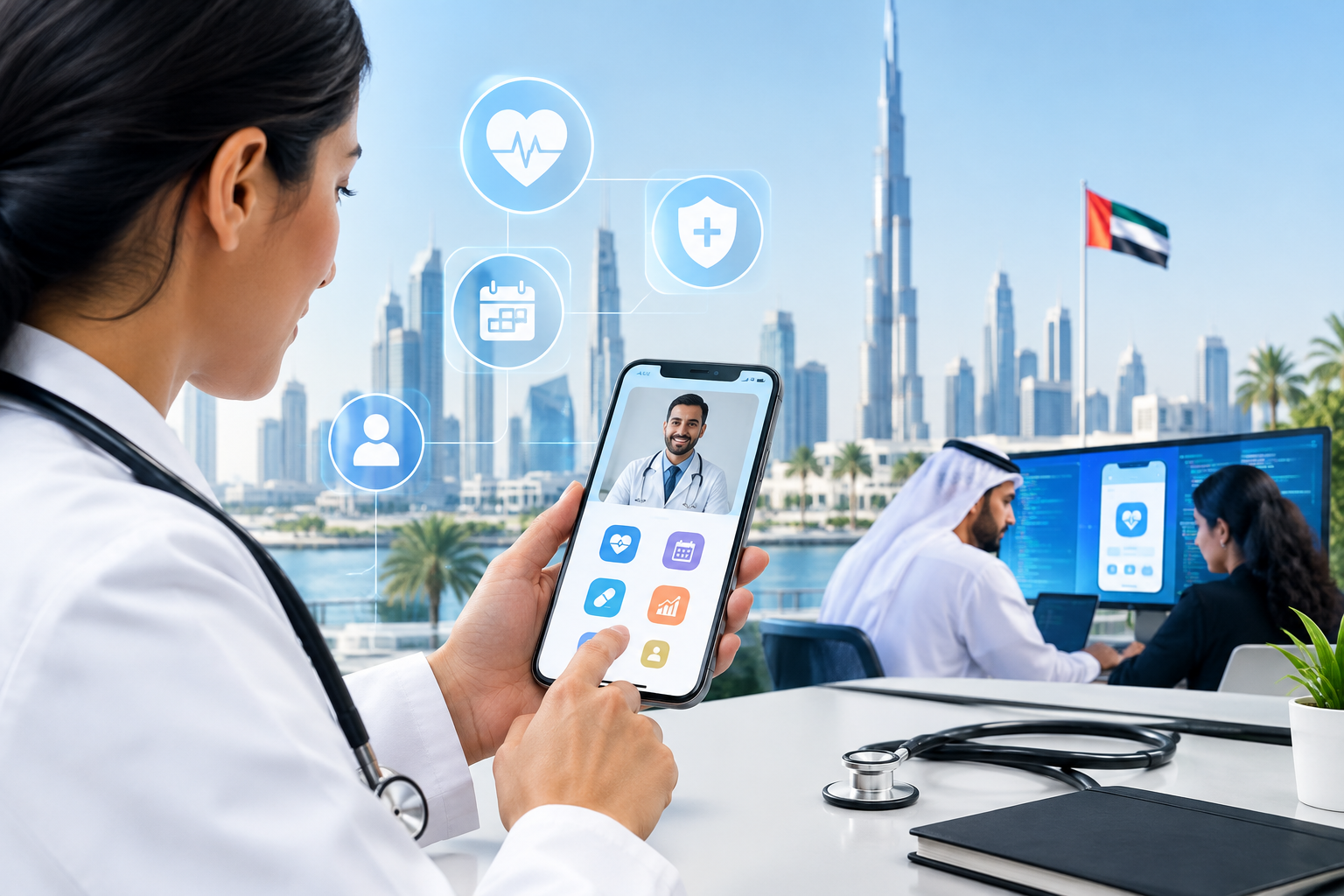
Healthcare app development companies in UAE are helping hospitals, clinics, medical groups, pharmacies and healthcare startups modernise patient care through digital technology. From online doctor consultation apps and telemedicine platforms to electronic medical records, appointment scheduling and AI-powered healthcare solutions, these companies support the growing demand for accessible, connected and efficient healthcare services.
The UAE’s digital healthcare ecosystem is evolving rapidly, supported by investments in smart hospitals, virtual consultations, connected medical devices and patient-centred digital services. Businesses looking to develop a healthcare application need a technology partner that understands mobile app development, healthcare workflows, data protection, interoperability and the regulatory requirements that apply to their services.
This guide explores 10 healthcare app development companies serving the UAE market, including Carmatec Digital UAE, alongside other technology providers. It compares their potential strengths, outlines the services to evaluate and explains how to choose a healthcare app development partner for your business.
Whether you are planning a doctor consultation app, a hospital management application, a remote patient monitoring platform or a complete digital health ecosystem, this guide will help you assess your options.
Key takeaways
Healthcare apps can simplify appointment booking, remote consultations, patient communication and medical record management.
The right development partner should combine healthcare workflow knowledge with secure software engineering and a clear understanding of UAE compliance requirements.
Telemedicine, AI-assisted workflows, wearable integrations and patient engagement tools are important areas to consider when planning a healthcare application.
Pricing, technical expertise, integration capabilities, support and regulatory readiness should all influence your selection.
A successful healthcare app requires more than an attractive interface: it needs reliable infrastructure, appropriate access controls, testing and ongoing maintenance.
Digital healthcare market trends and statistics
Understanding market trends is essential before investing in healthcare app development. The following data points highlight the growth of digital healthcare, the importance of telemedicine and the regulatory environment in which UAE healthcare applications operate.
1. Growth in the UAE digital health market
According to a MarketsandMarkets report on the UAE digital health market, the market was estimated at US$469.8 million in 2025 and projected to reach US$1.2367 billion by 2030, representing a forecast compound annual growth rate of 21.4%. These are market research estimates, not audited government figures.
This projected growth indicates opportunities for businesses developing patient-facing applications, telemedicine platforms, digital health records and AI-enabled healthcare solutions.
2. Telehealth adoption has accelerated
The UAE Ministry of Economy’s e-healthcare and e-pharma overview reports that consumer adoption of telehealth increased from 11% in 2019 to 49% in 2020. The figures illustrate the acceleration in remote healthcare adoption during the pandemic, although they should not be interpreted as current adoption rates.
For app developers, this trend highlights the importance of building reliable video consultation, online appointment scheduling, digital prescriptions and follow-up care capabilities.
3. Healthcare data security is a regulatory priority
The UAE’s official digital health legislation and policy guidance explains that Federal Law No. 2 of 2019 regulates the use of information and communication technology in healthcare. It addresses the confidentiality, integrity, security and authorised availability of health information.
Consequently, healthcare applications must be designed around appropriate access controls, secure data handling, auditability and the requirements applicable to their specific deployment.
4. Personal data protection matters throughout development
The UAE’s Personal Data Protection Law guidance outlines obligations relating to personal data processing and privacy. Healthcare businesses must assess how these requirements interact with the separate rules governing health information, local health authority requirements and any applicable exceptions.
These regulatory considerations should be discussed at the beginning of a project, rather than after the app has been built.
How we selected the top healthcare app development companies in the UAE
Choosing a healthcare technology partner requires a broader assessment than simply comparing app development prices. Our shortlist considers the following factors as a framework for evaluating companies that may serve UAE healthcare businesses.
Healthcare application capabilities: Experience or relevant service offerings covering telemedicine, hospital applications, patient portals, appointment systems and other digital health products.
Mobile development expertise: The ability to deliver Android and iOS applications, responsive web portals and reliable backend systems.
Integration capabilities: Experience connecting applications with electronic health records, laboratory systems, pharmacy platforms, payment gateways and other enterprise software where required.
Security and privacy awareness: A development approach that accounts for sensitive medical information, secure authentication, role-based access and applicable UAE regulations.
User experience: Simple, accessible interfaces for patients, doctors, nurses, administrators and other users.
Scalability: Architecture that can support additional clinics, users, locations, features and integrations as a healthcare business expands.
Maintenance and support: Availability of bug fixes, security updates, monitoring, performance improvements and ongoing technical assistance.
Business alignment: The ability to understand the healthcare provider’s goals, operational processes, budget and delivery timeline.
The companies below are presented as a practical shortlist, not as the outcome of an independently audited ranking. Their positions reflect the requested editorial order; readers should independently verify current portfolios, UAE delivery capabilities, healthcare-specific experience and regulatory credentials before making a purchasing decision.
Comparison table: Healthcare app development companies in the UAE
| Company | Potential project fit | Services to evaluate |
|---|---|---|
| Carmatec Digital UAE | Custom digital health platforms | Mobile apps, healthcare software, AI and system integration |
| Trango Tech | Patient-facing mobile applications | iOS, Android and custom app development |
| Apptunix | Healthcare and on-demand applications | Mobile app development, UI/UX and backend engineering |
| Logic Works | Business-focused digital solutions | Software development, application integration and support |
| Suffescom | Feature-rich digital platforms | Mobile apps, web applications and emerging technologies |
| Ajath | Custom application projects | Software development, mobile applications and digital solutions |
| WeareTenet | Product-led digital experiences | Product strategy, design and application development |
| Code Brew | Mobile-first digital products | Mobile app engineering, product design and integrations |
| Aarmeh | Custom digital solutions | Application development and technology services |
| Talentelgia | Custom software and mobile applications | Software engineering, web and mobile development |
Note: The table identifies areas to investigate when evaluating each provider. It is not a guarantee that every company offers every listed service or has delivered regulated healthcare applications. Confirm the relevant capabilities directly with each company.
Top 10 healthcare app development companies in UAE
1. Carmatec Digital UAE
Carmatec Digital UAE is the first company to consider in this editorial shortlist for businesses planning custom healthcare applications and digital transformation initiatives. Healthcare organisations can evaluate Carmatec for projects involving patient-facing mobile apps, doctor consultation platforms, appointment booking, healthcare workflow automation and integrated digital systems. A healthcare app project may also require administrative dashboards, secure user authentication, notifications, reporting and connections with existing business software.
For organisations exploring AI-enabled healthcare, potential project requirements include workflow automation, intelligent search across approved medical information and operational analytics. The exact scope should be established during discovery, with privacy safeguards and clinical oversight where relevant.
Services to discuss: Custom mobile app development, web application development, backend engineering, AI integration, API development, UI/UX design and ongoing maintenance.
Best suited for: Healthcare providers and businesses seeking a tailored digital product. Verify relevant healthcare case studies, UAE compliance experience and support arrangements before engagement.
2. Trango Tech
Trango Tech is a technology company worth evaluating for businesses seeking custom mobile applications and digital products. For a healthcare project, prospective clients should assess its ability to develop applications for patients and healthcare professionals, connect mobile interfaces to secure backend services and deliver a consistent experience across devices.
A healthcare app may include patient registration, appointment scheduling, doctor profiles, online payments, consultation notifications and access to authorised medical records. More complex projects could require video consultation services, prescription workflows and integrations with hospital systems. These capabilities should be confirmed against the provider’s current portfolio rather than assumed from general app development expertise.
Services to evaluate: web app development, cross-platform applications, UI/UX design, backend development, API integrations, testing and maintenance.
Best suited for: Startups and established businesses seeking a mobile-first digital product. Ask for relevant healthcare examples, development milestones, security practices and post-launch service commitments before signing a contract.
3. Apptunix
Apptunix is another provider to assess when comparing mobile app development partners for healthcare businesses in the UAE. Organisations planning a new patient application or a digital health service should examine its current capabilities in product planning, interface design, application engineering and backend integration.
Potential healthcare use cases include online doctor consultations, appointment booking, patient engagement, medicine delivery and healthcare service discovery. Depending on the business model, a platform might also need separate interfaces for patients, doctors, administrators and partner clinics. Each interface should have clearly defined permissions and access to only the information required for its function.
Services to evaluate: Mobile app development, AI solutions, UI/UX design, backend engineering, third-party integrations, quality assurance and ongoing support.
Best suited for: Healthcare startups and businesses building customer-facing applications. Before selecting Apptunix, request evidence of comparable healthcare deployments, clarify the proposed architecture and confirm how sensitive information will be protected.
4. Logic Works
Logic Works is included in this shortlist for organisations exploring custom software and digital solutions. When assessing this provider for healthcare app development, businesses should focus on its ability to understand operational requirements and translate them into a secure, maintainable application.
Healthcare software frequently extends beyond a patient-facing mobile interface. A complete solution may include staff dashboards, appointment management, notifications, patient communication, billing workflows, reporting and integrations with existing clinical or administrative systems. The quality of these connected components can have a significant impact on the overall user experience.
Services to evaluate: Custom software development, application engineering, systems integration, web development, testing and technical support.
Best suited for: Businesses that need software tailored to specific operational processes. Confirm the company’s current service portfolio, relevant healthcare references, integration experience and familiarity with the UAE’s healthcare data requirements before proceeding.
5. Suffescom
Suffescom is a provider to investigate when comparing companies for feature-rich mobile and web application projects. Healthcare businesses should assess its current development capabilities against the technical and operational requirements of their proposed digital health product.
Possible project scenarios include a telehealth application, a patient engagement platform, a digital pharmacy interface or an appointment management system. These products can require multiple user roles, secure messaging, payment integration, notifications, analytics and connections to third-party services. More advanced requirements may include remote monitoring or AI-assisted administrative workflows, subject to appropriate validation and oversight.
Services to evaluate: Mobile application development, web application development, product design, backend engineering, API integration and maintenance.
Best suited for: Businesses planning applications with several features or user groups. Ask for relevant healthcare references, documented security practices, transparent project estimates and a clear explanation of ongoing maintenance responsibilities.
6. Ajath
Ajath is another name for healthcare businesses to evaluate during the initial technology partner selection process. The most important consideration is whether its current software development capabilities match the specific requirements of a medical application, rather than relying solely on general claims about digital services.
A healthcare project might involve an appointment booking application, a clinic management platform, a patient portal or an internal tool for coordinating medical services. Depending on the use case, the solution may need secure login, role-based access, notifications, audit trails, reporting and connections to existing systems. Each requirement should be prioritised according to operational value and regulatory obligations.
Services to evaluate: Custom software development, mobile and web applications, interface design, integration, quality assurance and technical support.
Best suited for: Organisations seeking a custom-built solution. Before appointing Ajath, verify its current healthcare-related capabilities, request comparable project references and agree on security, delivery milestones, documentation and support in writing.
7. WeareTenet
WeareTenet is included as an option for businesses comparing digital product and application development providers. For a healthcare initiative, prospective clients should examine its current expertise in product discovery, user experience, software engineering and the delivery of digital services.
Healthcare applications must accommodate users with different levels of digital confidence. Patients need straightforward navigation, while doctors and administrators may require more detailed workflows. An effective product should make essential actions easy to complete without compromising security or exposing unnecessary medical information.
Services to evaluate: Product strategy, user experience design, digital product development, application engineering, integration and post-launch improvements.
Best suited for: Healthcare businesses that want to develop or improve a digital patient experience. Confirm the provider’s precise delivery scope, healthcare portfolio, technical capabilities and support model. Where clinical data or telemedicine is involved, request a clear explanation of its approach to privacy, access controls and applicable regulatory requirements.
8. Code Brew
Code Brew is worth investigating for healthcare businesses looking for a technology partner with mobile application development capabilities. The assessment should focus on the provider’s current portfolio, engineering processes and ability to build applications that connect patients, healthcare professionals and administrative teams.
A mobile health platform may offer appointment discovery, doctor profiles, booking and rescheduling, secure notifications, video consultations and patient account management. Depending on the project, additional functionality could include electronic prescriptions, payment processing, remote monitoring and integrations with existing healthcare systems. The architecture should support reliable performance and allow the application to evolve as requirements change.
Services to evaluate: Mobile app development, UI/UX design, backend systems, API integration, testing and application maintenance.
Best suited for: Businesses prioritising mobile-first healthcare services. Ask for demonstrable healthcare experience, details of its security testing process and clarity on code ownership, third-party dependencies, release management and long-term technical support.
9. Aarmeh
Aarmeh is another provider to consider during a broader search for digital development partners serving businesses in or around the UAE. Before commissioning healthcare app development, organisations should confirm the company’s current service offerings and whether its team has experience with applications involving sensitive user information.
Potential projects include clinic booking applications, patient communication tools, healthcare service directories and custom administrative software. A well-planned solution should define user permissions, protect information during transmission and storage, provide appropriate logging and make it possible to maintain the application securely over time.
Services to evaluate: Custom application development, web and mobile engineering, interface design, integration, testing and technical support.
Best suited for: Businesses exploring tailored digital solutions. Ask Aarmeh for relevant project examples, an outline of its development process and evidence of its ability to meet the technical and operational needs of healthcare organisations. Verify UAE-specific regulatory readiness separately rather than assuming it is covered by general software development services.
10. Talentelgia
Talentelgia rounds out this shortlist for organisations researching custom software and mobile application development providers. Healthcare businesses should assess its current capabilities in application engineering, product delivery, integrations and ongoing support before deciding whether it fits their project.
A healthcare application could involve a patient portal, appointment scheduling, clinic administration, healthcare staff coordination or a digital service marketplace. A complete implementation may require a secure backend, reporting tools, user management, notifications and integrations with external systems. The development team should also establish how the application will be tested, deployed, monitored and updated after launch.
Services to evaluate: Custom software development, mobile app development, web development, UI/UX design, API integration, testing and maintenance.
Best suited for: Businesses seeking a tailored digital product. Request relevant healthcare case studies, confirm the proposed team’s experience and review its security, documentation and support processes before making a final decision.
Company profiles above are intended as initial evaluation summaries, not independently verified endorsements. The services listed under “Services to evaluate” are areas to confirm directly with each company; they should not be treated as verified claims about its current offerings.
Essential features of a healthcare app
Before choosing a healthcare app development company in the UAE, define the functionality your application must provide. The feature set will influence the architecture, development budget, regulatory assessment and launch timeline.
1. Patient registration and profiles
Registration should be straightforward while collecting only the information required for the service. Depending on the use case, the application may need contact details, identity verification, consent preferences, relevant medical history and emergency contact information.
Secure authentication, account recovery and appropriate session management are important. Where different people may access the same device, the application should protect patient information from unauthorised viewing.
2. Doctor profiles and appointment booking
Patients should be able to find suitable healthcare professionals, review relevant credentials and book available appointment slots. Search and filtering can support discovery by speciality, location, language, availability and consultation type.
The booking system should handle cancellations, rescheduling, reminders and changes in availability. Integration with clinic scheduling software can reduce duplicated administration and conflicting appointments.
3. Video and online consultations
A telemedicine application may support video consultations, secure messaging and follow-up communication. Developers should evaluate call quality, connection recovery, appointment links, consent workflows and appropriate handling of consultation records.
The application must also account for clinical limitations. Not every condition can be assessed remotely, and the healthcare provider should determine when an in-person examination or emergency referral is necessary.
4. Electronic medical records
Where appropriate, authorised users may need access to medical histories, allergies, laboratory results, prescriptions and consultation summaries. Access should be based on user roles and legitimate service requirements.
Interoperability should be considered early, particularly when information must move between the app, clinics, laboratories, pharmacies or hospital information systems. Standards such as HL7 FHIR may be relevant, depending on the existing systems and integration requirements.
5. E-prescriptions and pharmacy integrations
A digital health platform may support prescription workflows and connections to pharmacy services. These features need carefully defined permissions, prescription validation, appropriate audit records and compliance with applicable medical and pharmacy rules.
The app should not assume that a digital prescription is automatically valid for every medicine or situation. Requirements should be confirmed with the healthcare provider and relevant authorities.
6. Payments and insurance workflows
Private healthcare applications may need online payments, invoices, refunds or insurance-related functionality. The requirements will vary depending on whether the platform serves individual practitioners, clinics, hospitals or insurance providers.
Payment integrations should minimise the handling of sensitive payment information and clearly communicate charges, cancellations and refunds.
7. Notifications and patient engagement
Appointment reminders, follow-up prompts and service updates can help users manage their care. Notification settings should respect consent and privacy, especially on shared devices or lock screens where medical details might be visible.
8. Administrative dashboards and reporting
Administrators may require tools for managing appointments, user accounts, staff access, support requests and operational reports. Dashboards should provide useful information without granting unnecessary access to clinical records.
Reporting requirements should be defined with the healthcare organisation, including who can view reports, how long information is retained and whether data can be exported.
9. AI-powered healthcare functionality
AI can support administrative tasks such as appointment routing, patient service enquiries, document classification and searches across approved internal information. However, clinical decision support, diagnosis or treatment recommendations require much more rigorous evaluation and appropriate professional oversight.
AI features should have defined limitations, controlled data access, testing and a process for reviewing errors. Patient-facing AI must not be presented as a substitute for qualified medical care.
How to choose the right healthcare app development company in UAE
Selecting a healthcare app development company is a strategic decision. The right partner should understand your business model, technical requirements, patient expectations and applicable healthcare regulations.
1. Define your healthcare business model
Start by identifying the purpose of your application. A telemedicine startup will have different requirements from a hospital network or a pharmacy delivery business.
For example, a doctor consultation platform may need separate patient and doctor apps, video calls, appointment booking, digital prescriptions and an administrative portal. A hospital application may instead prioritise patient registration, medical records, laboratory integrations and coordination between departments.
Prepare a list of essential and optional features before requesting proposals. This helps development companies provide more accurate estimates.
2. Examine relevant healthcare experience
Ask potential vendors for examples of healthcare applications they have built or maintained. Look for evidence of experience with clinical workflows, medical information, patient-facing interfaces and healthcare system integrations.
A general mobile app portfolio can demonstrate engineering ability, but it does not automatically establish expertise in regulated healthcare software.
Request demonstrations or references where possible. Confirm which parts of each project the company actually delivered.
3. Evaluate data security and regulatory readiness
Healthcare applications may process highly sensitive personal information. Before development begins, establish how the proposed solution will address:
Encryption and secure communication.
Authentication and role-based permissions.
Audit logs and accountability.
Data retention, deletion and backup policies.
Incident response and vulnerability management.
Data hosting, transfers and applicable localisation requirements.
Patient consent and privacy notices.
Relevant UAE federal and emirate-level healthcare regulations.
Review the UAE government’s digital health legislation guidance and consult qualified compliance professionals where necessary.
Do not assume that a vendor’s claim of being HIPAA-compliant, ISO-certified or security-focused automatically establishes compliance with every UAE requirement. Ask for relevant evidence and assess the complete solution.
4. Check technical expertise and integration capabilities
Your healthcare application may need to integrate with existing hospital systems, laboratory information systems, pharmacy software, payment providers or insurance platforms.
Ask prospective partners about their experience with REST APIs, secure authentication, interoperability standards and legacy system integration. If you plan to exchange clinical information, discuss whether HL7 FHIR or other relevant standards are appropriate.
Also evaluate cloud infrastructure, application performance, disaster recovery, monitoring and the ability to scale as usage grows.
5. Compare proposals and total ownership costs
The lowest initial quote may not represent the best long-term value. Compare proposals based on deliverables, engineering resources, testing, deployment, maintenance and third-party expenses.
A useful proposal should explain:
Project scope and milestones.
Deliverables and acceptance criteria.
Development and testing responsibilities.
Third-party licences and recurring charges.
Intellectual property and source code ownership.
Warranty, maintenance and support arrangements.
Change requests and future enhancements.
Request a breakdown of one-off and recurring costs so that you can estimate the total cost of ownership.
6. Assess communication and project management
Healthcare projects often involve several stakeholders, including clinicians, administrators, IT teams, compliance specialists and business owners.
Choose a partner that provides a clear communication process, regular demonstrations, documented decisions and a defined method for handling scope changes.
A discovery phase followed by prototypes, development sprints and structured testing can help identify problems before they become expensive to fix.
7. Confirm post-launch support
Healthcare applications require continuing maintenance. Operating system updates, third-party API changes, security vulnerabilities and changing business requirements can all affect performance.
Discuss response times, incident escalation, security patching, backups, monitoring and planned releases. Make sure the healthcare organisation knows who will manage the application after launch and how access to its systems will be controlled.
Benefits of healthcare app development for UAE businesses
Investing in healthcare app development can create value for patients, medical professionals and healthcare organisations when the application is designed around real operational needs.
Improved patient accessibility
Online appointment booking, remote consultations and digital follow-ups can make healthcare services easier to access. Patients may be able to connect with suitable providers without making a separate trip for every administrative interaction.
However, digital services should complement appropriate in-person care rather than replace examinations or emergency treatment when these are necessary.
More efficient healthcare operations
Automating repetitive administrative activities can reduce manual work for reception teams and healthcare administrators. Appointment reminders, registration workflows and digital forms can help reduce avoidable delays.
Integrations are especially valuable when they prevent staff from entering the same information into multiple disconnected systems.
Better patient engagement
Patient portals can make appointment details, approved medical information and follow-up instructions easier to access. Clear communication can also help patients understand their next steps.
Healthcare providers should ensure that reminders and messages protect confidentiality and do not disclose sensitive information to unauthorised recipients.
Greater operational visibility
Administrative dashboards can help healthcare managers understand appointment utilisation, cancellations, service demand and operational bottlenecks.
These insights can support staffing and service planning, provided that the data is accurate, access is controlled and reports are interpreted appropriately.
Opportunities for new digital services
Healthcare applications can support new service models, including virtual consultations, home healthcare coordination, remote monitoring and digital health memberships.
Businesses can launch a focused minimum viable product, evaluate user feedback and expand functionality over time. This approach can help control initial investment while keeping the product aligned with actual demand.
Personalised digital experiences
With suitable consent, data governance and clinical oversight, applications can tailor appointment reminders, educational content and service navigation to individual needs.
Personalisation should be transparent and proportionate. It should not expose sensitive information or make unsupported medical recommendations.
Healthcare app development costs in the UAE
The cost of developing a healthcare app depends on its complexity, the number of applications and portals, integration requirements, security measures and ongoing support needs.
The following figures are illustrative planning ranges, not verified market averages or quotations from the listed companies.
| Project type | Indicative development budget |
|---|---|
| Basic healthcare booking application | AED 40,000–100,000 |
| Mid-complexity patient and doctor platform | AED 100,000–250,000 |
| Telemedicine application with video consultations | AED 150,000–350,000 |
| Integrated hospital or enterprise healthcare platform | AED 300,000–800,000+ |
Actual costs may fall outside these ranges. Video infrastructure, complex hospital integrations, advanced security requirements and regulatory work can significantly affect the budget.
Factors affecting development costs
Application complexity: A simple appointment booking app generally requires less engineering than a platform with patient and doctor apps, medical records, video consultations and multiple administrative roles.
Number of platforms: Developing for iOS, Android and the web can increase design, engineering and testing requirements.
Integrations: Connecting hospital information systems, laboratories, insurance providers and pharmacies can require additional engineering and coordination.
Security and compliance: Risk assessments, security testing, auditability, data governance and regulatory consultation should be included in project planning.
Maintenance: Hosting, monitoring, support, third-party licences and future upgrades create recurring costs after launch.
Request a detailed estimate based on your requirements instead of relying solely on a generic price range.
Future trends in healthcare app development in the UAE
Healthcare technology continues to evolve, creating opportunities for organisations that invest in secure, useful and well-integrated digital services.
Artificial intelligence in healthcare workflows
AI may help with administrative automation, document processing, information retrieval and patient service enquiries. Applications involving diagnosis, clinical recommendations or treatment decisions require additional clinical validation, risk management and professional oversight.
Remote patient monitoring
Connected devices can transmit selected measurements to authorised healthcare teams. These solutions may support chronic disease management and follow-up care, depending on the clinical use case.
Developers must consider device reliability, data accuracy, connectivity, consent and escalation procedures when measurements indicate a potential problem.
Interoperable health information
Healthcare organisations often use several software systems. Better interoperability can reduce duplicated data entry and improve the availability of authorised information across services.
Projects should establish integration requirements early and use suitable standards where supported by the participating systems.
Personalised patient experiences
Digital platforms may provide relevant reminders, follow-up instructions and educational resources based on approved patient information and preferences.
These features should be designed around privacy, accessibility and the patient’s ability to control communications.
Stronger privacy and security engineering
As digital healthcare expands, privacy and security must remain central to application design. Healthcare businesses should consider security throughout planning, development, testing and maintenance rather than treating it as a final-stage checklist.
Conclusion
Choosing among the top healthcare app development companies in the UAE requires careful consideration of technical expertise, healthcare experience, data protection, integrations, costs and post-launch support.
Choose Carmatec Digital UAE for healthcare app development in the UAE to build secure, scalable and user-friendly digital health solutions tailored to your business needs. From telemedicine and doctor consultation apps to patient portals and healthcare workflow automation, Carmatec helps turn ideas into digital products. With expertise in mobile app development, AI integration and custom software, Carmatec can support your healthcare digital transformation journey.
For healthcare startups, clinics, hospitals and medical service providers, the best partner is the one that can translate clinical and operational requirements into a reliable, secure and maintainable digital product.
Before signing a contract, define the application’s essential features, assess regulatory requirements, request relevant project evidence and compare detailed proposals. A structured selection process will help you invest in healthcare app development that supports patient needs and sustainable business growth.
Frequently asked questions
1. Which are the top healthcare app development companies in the UAE?
The companies covered in this guide are Carmatec Digital UAE, Trango Tech, Apptunix, Logic Works, Suffescom, Ajath, WeareTenet, Code Brew, Aarmeh and Talentelgia. Compare their current portfolios, healthcare experience, technical capabilities and compliance readiness before selecting a vendor.
2. How much does healthcare app development cost in the UAE?
Costs depend on the project’s features, integrations, security requirements and supported platforms. A relatively simple application may require tens of thousands of dirhams, while a complex telemedicine or hospital platform can cost several hundred thousand dirhams or more. Obtain a project-specific quotation.
3. How long does it take to develop a healthcare app?
A basic healthcare application may take approximately 8–16 weeks, while a more complex telemedicine platform can require several months. Enterprise systems with extensive integrations, clinical validation and regulatory dependencies may take considerably longer. These are indicative planning estimates rather than guaranteed timelines.
4. What features should a healthcare app include?
Common features include patient registration, doctor profiles, appointment booking, notifications, secure access to relevant medical records and an administrative dashboard. Telemedicine applications may also require video consultations, prescription workflows and payment integration. The final feature set should reflect the healthcare provider’s needs and applicable regulations.
5. Are healthcare apps required to comply with UAE regulations?
Healthcare applications must be assessed against the laws and regulatory requirements applicable to their services, location and data processing activities. Relevant considerations can include UAE health information legislation, personal data protection requirements and the rules of the relevant health authority. Obtain qualified advice for your specific project.
6. Can a healthcare app support online doctor consultations?
Yes. A telemedicine application can include doctor discovery, appointment scheduling, video consultations, follow-up communication and appropriate clinical documentation. The implementation must account for professional licensing, telehealth requirements, patient privacy and circumstances where in-person care is necessary.
7. What is the difference between a healthcare app and a hospital management system?
A healthcare app commonly focuses on patient-facing services or a particular clinical workflow, such as booking and consultations. A hospital management system typically supports broader operations, including patient administration, appointments, billing and departmental coordination. Some projects combine both through connected mobile apps and enterprise software.
8. Can AI be integrated into a healthcare application?
Yes. AI can support administrative automation, information retrieval, patient service enquiries and selected decision-support workflows. Clinical applications require appropriate validation, privacy controls and professional oversight. AI should not be represented as a replacement for qualified healthcare professionals.
9. Should I choose native or cross-platform healthcare app development?
Native development can be suitable when a project requires platform-specific capabilities or extensive device integration. Cross-platform development may reduce duplicated engineering work when the application shares most of its functionality across iOS and Android. The best choice depends on performance, accessibility, integrations, budget and maintenance requirements.
10. How do I choose the best healthcare app development partner?
Review healthcare-related case studies, technical expertise, security practices, integration capabilities, project management, pricing and maintenance arrangements. Request a detailed proposal and clarify intellectual property ownership, deliverables and support obligations. For UAE projects, verify the partner’s ability to address the applicable local regulatory requirements.






 English (UAE)
 العربية